
Ep 183: Building a More Accessible Future in Fertility Care with Dr. Amelia Kelly
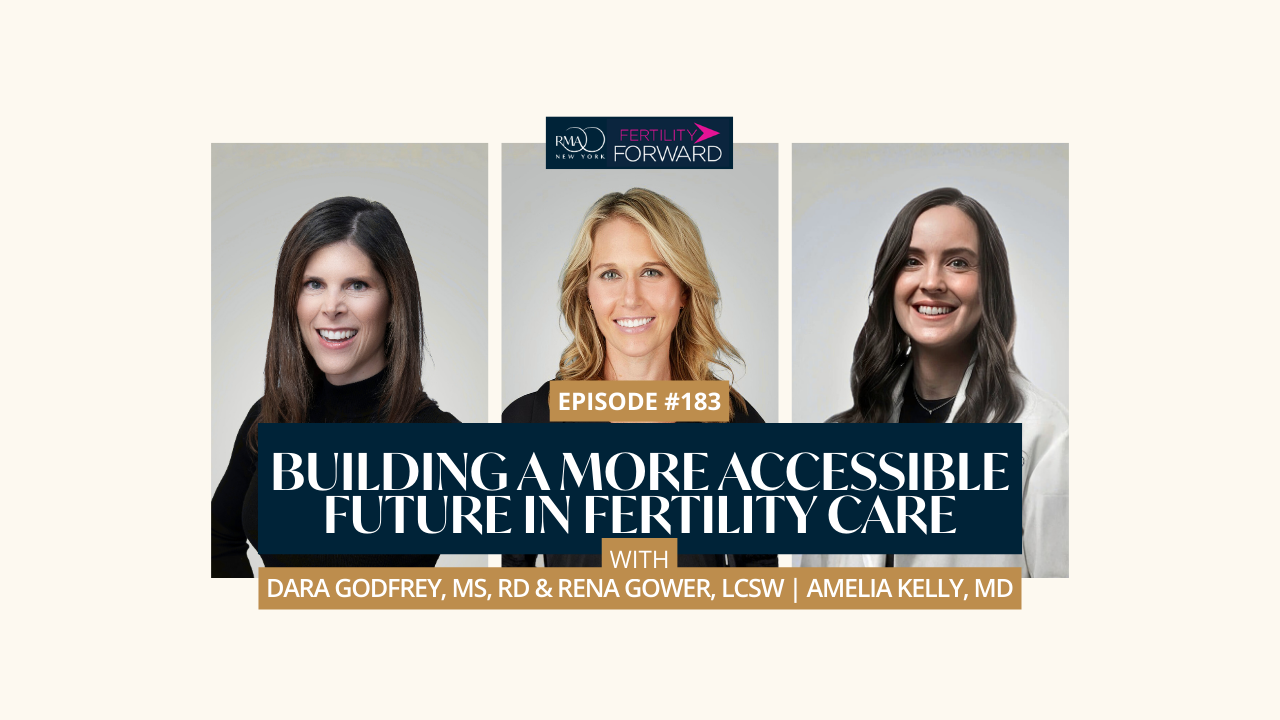
Fertility Forward Episode 183:
Sometimes the most powerful insights in fertility care come from lived experience. In this episode of Fertility Forward, we sit down with Dr. Amelia Kelly, the newest reproductive endocrinologist at RMA of New York’s Brooklyn office, to explore the personal and professional journey that brought her to this field. She shares how her mother’s volunteer work in reproductive health first opened her eyes to the importance of family building on your own timeline, and how training at institutions like Weill Cornell and NYU strengthened that early interest. Dr. Kelly also reflects on her own egg freezing experience and how it shaped her understanding of what patients navigate. We discuss her research on physician infertility, the stresses residents face, and why expanding access to care remains one of her biggest passions. Tune in to hear how Dr. Kelly’s path as both clinician and patient informs her approach and why compassionate, accessible fertility care matters now more than ever!
Rena: Hi, everyone. We are Rena and Dara, and welcome to Fertility Forward. We are part of the wellness team at RMA of New York, a fertility clinic affiliated with Mount Sinai Hospital in New York City. Our Fertility Forward podcast brings together advice from medical professionals, mental health specialists, wellness experts, and patients because knowledge is power and you are your own best advocate.
Dara: Today we have on our podcast Dr. Amelia Kelly, who is our newest reproductive endocrinologist and infertility specialist at our Brooklyn RMA office. She is a board-certified OBGYN and also serves as an assistant clinical professor at the Icahn School of Medicine at Mount Sinai. She completed her residency and fellowship at New York University and her medical school training at Weill Cornell Medical College. She is passionate about improving access to fertility care to all populations and helping her patients achieve their family-building goals. Thanks so much for being here, Dr. Kelly. So nice to meet you!
Dr. Kelly: So nice to meet you both, and thank you so much for having me. I'm really thrilled to be here and also so happy to have joined the RMA family.
Rena: Yes, welcome! We are so happy to have you and joining our Brooklyn office and the great crew of doctors we have there.
Dr. Kelly: Yeah, it's a fun team.
Rena: So tell us a little bit about you and how did you get into reproductive endocrinology?
Dr. Kelly: Absolutely. So I'm originally from Denver, Colorado, and growing up, my mom was actually really involved in volunteering for Planned Parenthood for the Rocky Mountains. And I think she really instilled in me an interest in reproductive healthcare early on and taught my sister and I the importance of people being able to have children on their own timeline. I went on to the University of Michigan for undergrad and did the pre-med track and studied biology. And then I came to New York in 2014 to go to medical school at Cornell. And it was at Cornell that I became even more exposed to the field of reproductive endocrinology and infertility, or REI. I was able to do some research with their team there and became fascinated by how young the field of REI was and also how much the technology was growing and changing in a short amount of time. But even more importantly, I got to see how patients' lives were transformed by this technology and how this field really changes the trajectory of someone's life and their family's life. And I found that to be just so rewarding. I then went on to NYU for my residency. I was lucky to work at Bellevue there. And really, I think anyone who works at Bellevue is, becomes passionate about access to care. And that's the one thing I found challenging about REI is that how limited at the time, a very limited amount of people had access to just basic fertility care. And I think that's getting better now, but that is something that I'm still passionate about. As a resident, I learned that even healthcare, a lot of healthcare providers don't have any access to care. I was able to stay at NYU for fellowship and in fellowship, I actually did gain access to fertility coverage and was able to do a few egg freezing cycles. And I think going through this experience as a patient actually made me feel comfortable about pursuing my career and building my family on my own timeline. And so I'm hopeful that having had this experience as both a patient and a medical provider, that my patients will find me that relatable because I've gone through the experience myself.
Rena: Wow, what a what a journey. And I love that it started with your mom. I think that's amazing. So shout out to your mom. That's wonderful. And I think similar to Dara and myself, we can both relate about having gone through this ourselves to then have us be in this career as well. And I totally agree with you and I think that always resonates with patients because I think it just makes them feel that you really understand and you're not just talking at them to know that you've gone through it, come out the other side, and can relate on that level also.
Dr. Kelly: Yeah, definitely. I think it's something you can't really understand, even if you have the training, you know, to have to be injecting yourself with Menopur at 7 p.m. And you're like, oh my gosh, I remember thinking, like, I'm the one on call! If I can't figure this out, like there's no one to call. But it's way more stressful when you're in it yourself, I think. And it's so easy over the phone to say, oh, you just mix this milliliter of fluid with this powder and then you inject it. It's but when you're actually doing it yourself, it really is way more challenging. And I have experience with needles and health in surgery. I've practiced surgery, you know!? So for patients who have no experience in the medical field, I can imagine it's extraordinarily stressful.
Rena: And I think, yeah, you know, being able to relate to them on the level of, you know, if they talk about sort of, you know, not feeling great in their body or the things that you might have to give up that you really can understand that also.
Dr. Kelly: Definitely.
Dara: I love your trajectory. I love that you wento Cornell, which I believe Rena, isn't that where you went?
Rena: Uh yeah, Cornell undergrad.
Dara: Okay.
Dr. Kelly: The medical school is in New York City. So I've actually going to Ithaca is on my bucket list. I've never been.
Dara: I didn't realize that.
Rena: It's always well, you know what they say. Ithaca is gorgeous.
Dr. Kelly: And they spell gorgeous, like gorge is right. Yeah. Because it's uh the whole thing. But yes. Well, I would recommend maybe waiting for the spring to go.
Dara: I was just gonna say, I don't think the winter months would be your best time to venture out there. But uh that's exciting. So now you're in the Brooklyn office, and which is a beautiful, a beautiful office to be at. Is there anything specific in the fertility realm? So you kind of did mention that you have a great interest in access to care.
Dr. Kelly: Yeah.
Dara: I'm super curious to hear, is there any type of research that you in particular may want to do or any research that you have looked into recently in this area?
Dr. Kelly: So as a resident and fellow, I was involved in the American Medical Women's Association or AMWA's task force on physician infertility. So it's surprising that one in four female physicians have infertility, which is much higher than the rate of the general population. And we still don't really understand why. But through that group, I was able to do some survey research. They have asked to a broad network of medical students and physicians. We did large survey research on people on healthcare workers, their path to family-building. And we learned that a lot of healthcare workers, um, physicians and medical students want improved access to care. Medical students are asking about freezing their eggs and residents too, and that they have higher rates of infertility and needing to go through IVF themselves. So that is something that I've done some research on. I think it's harder to study broader populations, but we know that broader population, that access to care is a huge issue. And I'm really glad that a lot of corporations have have started to include fertility insurance coverage for their workers. And I think that's just continuing to expand in this current administration. So I'm hopeful that in the timeline that I'm working, that more, like more and more patients will have insurance. I think even in the last five years, I've noticed a huge increase in the number of patients coming to us who have insurance coverage.
Dara: I was gonna say we had someone on our podcast that's gonna be released hopefully in the coming months, who is a fellow doctor who, you know, has been going to Washington and speaking with the government to see how we can, you know, expand access to care. So I feel like we're gonna see a lot, I'm hoping, in the next year or so with big changes. But I'm interested in there's I'm curious as to why are your thoughts as to why the residents have a higher rate of infertility? Is it because starting family building later? Is it the stress? Is there any to find out any connections?
Dr. Kelly: Yeah, it's this is also hard to study because it's all observational. So uh, but there are lots of theories why I think you know, residents tend to work irregular hours, really long hours. They have irregular sleep-wake cycles, and we know that the secretion rhythm is important, is is linked to fertility. It could be related to stress. I think they do delay family building. But it's interesting because they could even compared to other professional fields, it seems that healthcare workers are particularly vulnerable to having infertility. So I don't think we fully understand why it is.
Rena: That is so interesting. And I have to say, I actually have a fair amount of physicians as patients. And so really sort of I kind of already knew this, but learning even more from them, it's such a hypocrisy that you know, healthcare workers just have so little benefits, they have so little opportunity for self-care. And in fact, I would say my physician clients are in the worst health out of anybody. You know, especially my clients that are residents or fellows, because they don't have any time to take care of themselves.
Dara: I was gonna say the same thing. I see so many, I mean, residents, fellows, nurses who, you know, are are there helping other people who are unwell and they themselves skip meals, don't have time to go to the bathroom throughout the day, so they're not drinking. The crazy work hours. I think that you're right, the circadian rhythms. I mean, you know, hormones, I'm sure, are all out of whack when you're not getting consistent a consistent sleep schedule.
Dr. Kelly: Right, right. Yeah.
Rena: Yeah, that's such a nuanced thing to pursue, but I think there's such a need for that to figure out how to make it better for healthcare workers.
Dr. Kelly: Definitely. And I think if healthcare workers could be an example for other organizations and groups, I mean, you know, amazing that I think a lot of technology fields have expanded access to care and have amazing benefits. But we ourselves, I think there's still a lot of room to to grow and improve.
Rena: Of course. And then also the the length of mat Leave and what's offered.
Dr. Kelly: Right. Yeah, definitely.
Dara: So I'm from Canada. I'm like, we have it pretty good in Canada. We need to work harder here to um, you know, at least I'm happy to see now that there's you said the word before, like the partners, like the male care or like is it mat leave for men? What do they call mat leave for men?
Rena: Paternity leave
Dara: Paternity leave. That's the word. Yeah. I mean, the paternity leave is phenomenal. My kids at their school, a lot of men go on it. And just like the fact that, like, when we were younger, that did not exist.
Dr. Kelly: Definitely.
Dara: But we know we still have a ways to go.
Rena: There's still a lot of room for improvement.
Dara: Definitely. Well, we're so happy to have you on board. Where can we find you to best book an appointment with you?
Dr. Kelly: Yes. So if people are navigating the RMA website, you can go to look under our team. There's the list of physicians. I am listed as one of the physicians there. And if you click on my profile, you can click book an appointment with me. So I think that is the easiest way to go ahead and book an appointment. But also calling the main office is another way as well.
Dara: That's great.
Rena: Well, it was so lovely to have you on and get to know about your journey and path to get here. And so wonderful to know we have such another dedicated physician on the team to provide such great care.
Dr. Kelly: Yes, thank you so much for having me. I'm really excited to be here and like I said, to be part of the RMA family. It's been a it's a great group of people, and I'm really happy to be on board.
Dara: We're excited too. So, how we end our sessions are always with words of gratitude. So we're gonna put you on the spot, Dr. Kelly. But what are you grateful for today?
Dr. Kelly: I have a 10-week old at home, and I'm really grateful to have her in my life. It's I don't take that for granted at all being in this field.
Rena: I love that.
Dara: It's a lot of work. You look if you can't, if you can't see her right now, Dr. Kelly looks very well rested for someone who has a 10-week old. I hope you're getting some sleep.
Dr. Kelly: Thank you. Thanks again for having me.
Dara: Before we finish it, Rena, I want to ask you, what are you grateful for?
Rena: I am grateful for the kindness and understanding of others when things don't go your way. I was a little bit stressed making this episode because of having to pivot and take my daughter somewhere. But both of you ladies were so flexible and understanding, and I put a lot of pressure on myself as a working mom. And I don't like to be late or reschedule, and it's not often that I asked for that. So thank you both so much for that. And I'm hoping people to see other working women and working moms, particularly, who understand. So that is my gratitude.
Dara: I love that.
Rena: What about you, Dara?
Dara: I'm grateful for slowing down. It actually was so nice to start a little bit later than we had anticipated. I got a chance to chat with Dr. Kelly for a little bit and connect with her. So I'm actually grateful for some of the unexpected moments. I, you know, I think in life, uh, many of us, including myself, like to know how things, you know, we want to control the outcome. And and it actually, I think, where the beauty really lies in the unknown. When when things don't go exactly according to plan, is really, I think, when you can be surprised. You can get a lot of good nuggets out of those moments. So I'm very grateful for that.
Rena: Well, a-woman to that.
Dara: A-woman to that. Thanks again, Dr. Kelly. We can't wait to have you on again down the road. Maybe if there's any research in the you know, fertility access or anything in that realm, we would love to have you back on. But wishing you all the best with your newborn and with uh your started RMA.
Dr. Kelly: Thank you so much.
Rena: Thank you.
Dara: Thank you so much for listening today. And always remember - practice gratitude, give a little love to someone else and yourself, and remember: you are not alone. Find us on Instagram @fertility_forward and if you're looking for more support, visit us at www.rmany.com and tune in next week for more Fertility Forward.