
Ep 185: The Power of Choosing Single Motherhood with Eboni K. Williams
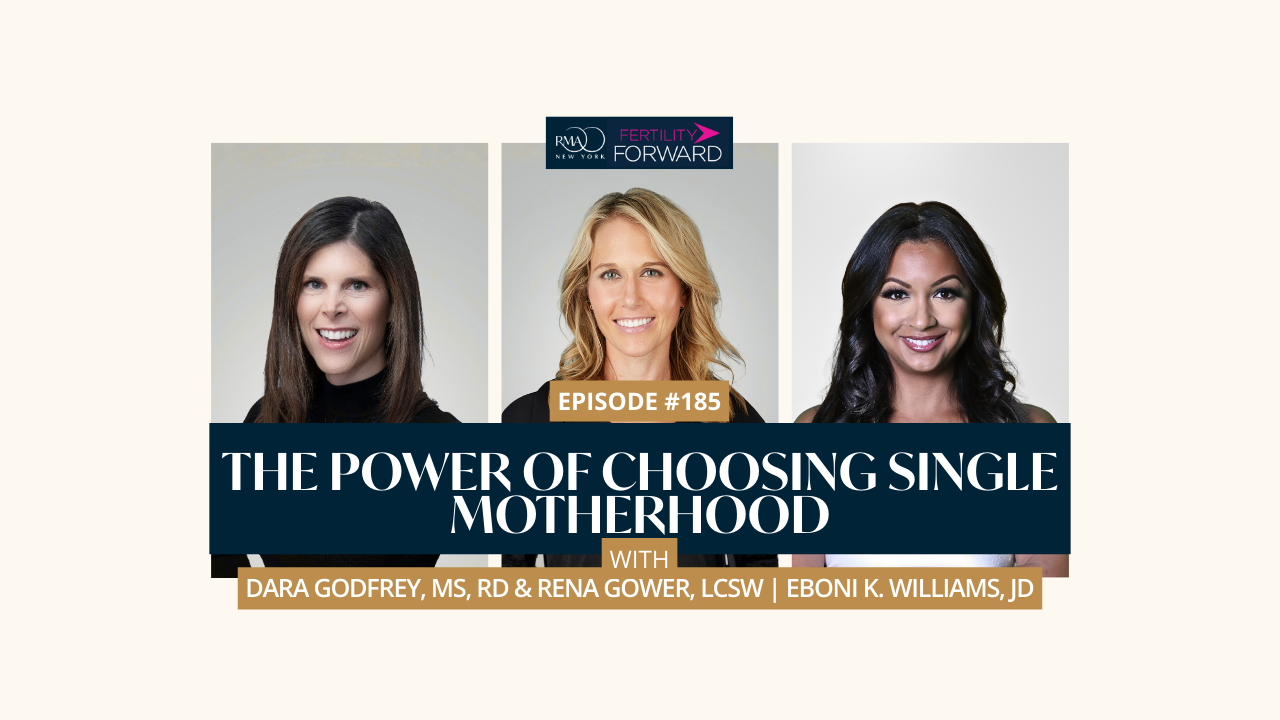
Fertility Forward Episode 185:
In this episode of Fertility Forward, hosts Rena and Dara welcome Eboni K. Williams —acclaimed lawyer, author, and television host—for a powerful and personal conversation about her journey to single motherhood by choice. Known for her work on Equal Justice with Judge Eboni K. Williams, Holding Court with Eboni K. Williams, and as a former cast member of The Real Housewives of New York City, Eboni shares how she froze her eggs at 34 to preserve her options and later conceived her daughter, Liberty, through donor sperm and IVF. She speaks candidly about female self-sufficiency, taking ownership of fertility decisions regardless of relationship status, and challenging the stigma often attached to single parenting. This episode offers an empowering perspective on reproductive planning, intentional motherhood, and the importance of building a strong support system along the way.
Rena: Hi everyone, we are Rena and Dara, and welcome to Fertility Forward. We are part of the wellness team at RMA of New York, a fertility clinic affiliated with Mount Sinai Hospital in New York City. Our Fertility Forward podcast brings together advice from medical professionals, mental health specialists, wellness experts, and patients because knowledge is power and you are your own best advocate.
We are so excited to welcome to Fertility Forward today Eboni K. Williams. She is an American lawyer, author, and television host. She hosts and is executive producer of Equal Justice with Judge Eboni K. Williams, a nationally syndicated court television show. Additionally, she hosts and is executive producer of the NAACP Image Award-winning, Holding Court with Eboni K. Williams. In addition to frequently guest hosting The View and The Breakfast Club, Williams starred on season 13 of The Real Housewives of New York City, becoming the show's first black cast member ever. Her best-selling book, Bet on Black: The Good News About Being Black in America, hit shelves in January 2023. Thank you so much for joining us today, Eboni. What a bio!
Eboni: Thank you. Oh, thank you! Really excited to chat with you today. And I just feel really blessed to be able to participate in this conversation. I think it's really important.
Rena: Well, thank you so much for joining. And tell us how that impressive bio, how you are tied to our podcast, which of course focuses on all things fertility and women's health.
Eboni: Yeah. Well, I am a very, very, very happy and satisfied client, patient of RMA in New York, specifically. Shout out to the West Side Clinic! And Dr. Daniel Stein was and is such an important piece of my story and now my legacy. I first visited with RMA and Dr. Stein in my early 30s, relatively early 30s. I had a very good sorority sister who had been a patient and had frozen eggs in her early and mid-30s, and she recommended that I think about it. You know, this was kind of, if we can harken back to like 2014, 2015, when egg freezing, I would say, there was a certain sector of I think New York City professional women that were like being introduced to this. This was very topical. They were like, egg freezing parties and all these things, but still like not a lot, lot known about it, right? Still kind of, I don't know if it was even clinically still experimental at that time, but I think very shortly thereafter it became, you know, beyond the experimental phase. Anyway, this girlfriend, this sorority sister was like, you should think about it, you should do it. If nothing else, go. And I was 33 at the time. She says, go get like a baseline checkup around your fertility. I think it's important to note, I was not then, nor have I ever been a woman who was like, deadset on kids. That wasn't my experience. And shout out to all the women that knew they wanted to be moms from the time they were five years old. And, you know, that was always a part of their trajectory. That wasn't my story. I grew up in the South. I'm from North Carolina by way of Louisiana.
Rena: I'm from North Carolina!
Eboni: Oh, yeah. I grew up in Charlotte. Yeah.
Rena: I grew up in Durham. We'll have to sidebar about that later.
Eboni: Yeah, yeah. Well, I had a great week. I hope you did. That's a little Carolina-Duke reference.
Rena: Yes. Yes, I yeah, yeah, yeah.
Eboni: I think I know what side of the coin you're on by that response, but that's okay. Back to these eggs. Okay, so I said, I'm not sure I don't want kids. And I want, I think that's very important because I think that sometimes people think that to even broach the fertility conversation or even start getting baseline checkups and things, you have to be certain that you want to be a mother. And I just want to share that I disagree with that premise. I think that if you want the option, for me, this was all about preserving optionality, right? I, like I said, grew up knowing that I wanted to be a professional. I always wanted to be an attorney. I wanted to probably own my own business one day. So I was very much like I call myself a grandma millennial. I very much grew up in an era where I think young girls and women, for almost the first time in huge numbers, were given permission and even encouraged to center career and professional ambition, right? And I think that a lot of the narrative around that, even today, can be very binary, that if you are a young woman who is very ambitious professionally, that either you do that at the expense of motherhood and family, or it becomes secondary or whatever that is. I just want to push back on all of that entirely and say that I am of the belief that women can have it all, not necessarily at the same time, which we'll get into, but I certainly think that we should pursue all of the desires of our heart. So, in that vein of thinking, I said, if there is an optionality to help preserve fertility now, again, I'm 33, turning 34. Let me see what it's all about. Let me just go get educated on this and see if it's something I want to pursue in the spirit of preserving option for biological children at some point down the road. So, yeah. So, anyways, went in, kind of got the basic work up of looking at follicles, seeing where I was, checking baseline blood work. Dr. Stein was like, hey, listen, you're in pretty good shape. But if you think that you might want a biological child at some point down the road, I do think you're a good candidate for egg freezing and that level of fertility preservation. So within the year when I was 34 years old with Dr. Stein, we did an egg retrieval. So I froze eggs and, you know, retrieved 10 that were mature, and that was what we put on ice, so to speak. And frankly, I didn't think any more about it. I went on with my life. I went on with my career, you know, as New York tends to do in terms of pace. And then some things happened. I, career had success, met a man, got engaged, thought that maybe we would pursue children and family in a more traditional way. So still not thinking about these eggs. Oh, I should note in this story that I froze my eggs while I was in the beginning of that relationship. Because I think that is another misconception that people and women think that you only freeze the eggs if you're single with no prospects, right? So it kind of can take on this doomsday worst case, last resort scenario type of narrative. And I also want to aggressively push back on that. I say this in jest, but also in all sincerity: do not allow your boyfriend, fiance, or frankly, maybe even your husband to get in the way of your future children. So I just think sometimes alignment can go another way on this issue of children. And you definitely, I just think, put yourself in the best position again for most options by taking full accountability and responsibility for your fertility in your own right as a woman. And so I froze those eggs while in a relationship with a man that I for sure could see having children with outside of IVF or with it, right? But I didn't want to forego any optionality because of that relationship. And I'm so glad I did because ultimately, after about four years, that relationship had its sunset. And I woke up and I was 38 on the other side of this pandemic in 2022, which would have made me about 38 years old. And I said, you know, I bought my first condo here in the city. Work could not have been going better. I feel like for the first time I was in a position to potentially become a mother and give a child a great life. And I wanted to pursue it. So I went back in in August of 2022 and met with Dr. Stein again. And I said, you know, doc, he's like, How's that fella you're seeing? I was like, what fella? He's gone, he's done. Toast. Uh he's like, okay. I said, and I've been hearing about this thing called single motherhood by choice, which I had been introduced to in podcasts and articles and things. And I said, and I think I might be curious about it, Doc. And he said, okay. He said, well, let's check everything out. And so we did another kind of look-see at where I was fertility-wise. And I still had some follicles left. But he said, Listen, Eboni, if you're serious and you think you want to pursue single motherhood by choice, we should get on it and we should do it. And you have an option. You can either do another retrieval now and we see what we get around eggs, or we can start with the 10 frozen eggs you already have here at the clinic. And obviously, I was going to be using donor sperm. I shouldn't say obviously, because there's a bunch of different pathways for single motherhood by choice, which we can discuss. But I knew for me I wanted to use a donor from a cryrobank. And yeah. And so I got advisement from Dr. Stein and the team about what I should be looking for around selecting donor sperm. I found a fantastic candidate that I felt really good about. And within six months, we created embryos. We created embryos. We genetically tested those embryos. I ended up with two embryos that made it to blastocyst. Of the two, only one was chromosomally normal. And that embryo is now my 18-month-old daughter, Liberty.
Rena: Wow, what a story.
Eboni: Yeah, yeah, it's insane. And I feel remarkably blessed and just excited to share.
Rena: Yeah.
Dara: I'm curious to hear about your support system. Did you feel supported throughout the process? I mean, you initially said that your friend was the one that recommended you to the clinic. Was she there? And, or did you have family and, or friends to help you out?
Eboni: Brilliant, important question. I built community for the sake of this journey. I knew enough to know this was not as amazing and a superwoman as I am. Nobody can do this alone, right? Nobody can do this alone. It's not designed to be done alone. So, yes, yes, yes, I had community. Now, my family situation is a bit unique in that I don't have traditional biological family. I'm an only child with no paternal, you know, relationship, and my mother simply was not available for this journey. So it was just me in terms of family, right? In the traditional way, but my friends have become my family, my family of choice and selection. So, yes, that same friend that recommended I explore the egg freezing piece was literally there in the waiting room for my embryo transfer. She's amazing, but we went out for mocktails right after and you know, celebrated the possibility of what could be to come. Also, I have a very best friend that I've been friends with since freshman year at the University of North Carolina at Chapel Hill, right? I'm just kidding.
Rena: I didn't hear that. Oh, he'll edit that out. She said Duke. She said Duke, we're fine.
Eboni: Isn't that spelled D-O-O-K?
Rena: Okay. Let's see.
Eboni: I'm just kidding. No, but my best friend from college, who's my very best friend to this day, she's Liberty's godmother now. She was there with me in labor and delivery, you know, which was not the plan because again, I'm a superwoman. And I was like, oh no, I hired my doula, I've got a great OB. It was just gonna be us. And she's like, F that. I am not letting you bring this little girl into the world alone. And she was there for all 45 hours of labor.
Dara: Wow. You are a superwoman! You could be a superwoman and want a sidekick for motivational and emotional support.
Eboni: She was so necessary in retrospect. So she's great. And beyond that, yeah, also just other friends and sorority sisters and link sisters, which is an amazing org I'm with now, that have just shown up for me in ways that I didn't know I would have access to. They have been the aunties and the fairy godmoms of Sweet Liberty this whole way. And in addition to that, I would be remiss to not speak of the importance in my situation for frankly hired support as well, right? So especially as a solo mom by choice, I knew that I alone would not be positioned to go through the immediate, you know, the fourth trimester, as we call it, immediately post-birth through those first three to four months alone, because I wanted to be able to function in some capacity. So I had a night nurse who was phenomenal. I can't even imagine getting through that period without her. So you know, I hired her when I was in my second trimester, as you might imagine. I'm a bit type A.
Dara: You have to. You have to.
Eboni: Yeah, yeah. The good ones, you got to get on board early. So, like literally, I hit 13 weeks and I was like, all right, sign us up, you know. So I hired and got one of the most amazing night nurses in the world. And she was there with us every step of the way, Monday through Friday, 8 p.m. to 8 a.m. So I actually got some sleep. And then beyond that, I've enjoyed a wonderful nanny-share with one of my sorority sisters. And Liberty is in a fantastic, you know, preschool daycare that's bilingual with French and English teachings. And between all of those pieces, right? I feel very supported.
Rena: That's amazing. And I'm so glad that you spoke about the importance of just building a village. Yes. And also it can be “untraditional”. You know, I have a lot of clients that are contemplating becoming a single mom by choice. And then, you know, fears about finances or support or how to juggle work and single parenthood, you know, always arise. And I'm wondering what you would offer as of wisdom or advice to someone, you know, very much such as yourself. You know, I always say I love the women I work with, they're all these like badass, successful women. And then I think the idea of becoming a single mom by choice, it feels super daunting. So, what might you say to them as words of encouragement or advice?
Eboni: I mean, I listen, don't allow me to paint a utopia. It's not perfect, nor is it easy. But one of the single moms by choice that was inspirational to me is a woman named Katie Bryan. She has a fantastic podcast called The Single Greatest Choice. Check it out. She talks about choose your hard, right? Choose your hard in life and particularly when it comes to motherhood. So while signing up to be a single mom, even by choice, certainly has its challenges, whether it's resources, whether it's community, what that looks like, all the things. There are challenges of bringing children into the world partnered as well, right? That are obvious, some not so obvious. You know, we are now hearing more and more married women or partnered women talk about incongruencies of labor division when it comes to parenting and all types of things. So my words to a woman contemplating single motherhood by choice is try to consider the 360 of this possibility and this decision. Reject the urge to think of this as a path of last resort or of downtroddenness or pure hardship, because it certainly has not been my experience. But this is about the ability, I think, to forecast and put in place safeguards, such as community, as you're talking about, Dara, such as you know, just trying to think around the things that you anticipate you and your child's needs might be, and then move forward, and knowing that life is full of surprises, nothing is guaranteed, but frankly, it wouldn't have been guaranteed anyway, even in a partnered capacity. So this is really about self-trust. This is, I think, very much about knowing that ultimately what children and even babies need is a lot of love and a lot of intention and trust your own ability to build the plane and fly it, so to speak, at the same time. This isn't about having all the answers on the front end of your journey. This is truly about learning and figuring things out in real time. For example, Liberty was like eight months old here and thriving before I realized that babies didn't need to drink formula past the age of 12 months. Like I had no idea. And I felt a little embarrassed about that. Like, shit, like I don't know what these steps are because my way of not getting overwhelmed in this whole thing is I think about this in three-month sectors the whole time. Like, so even like when I was pursuing conception, I was like, let's just think about the next three months. Let's think about the three months in front of us. Once I conceived, we're thinking about first trimester, you know, and building on that. And when she was born, we're thinking about zero to three months. I told everybody, don't send shit to this house for like 18 months and 25, girl, no! Like. we are in the first.
Dara: You would not have liked my gift because I'm a planner.
Eboni: There you go, right, right. And I love that, but I was like, I know me, I will get in my head, I will get overwhelmed. We are zero to three months, then we're gonna go three to six and six to nine, and you get it. And that has been really successful for Liberty and for me thus far.
Rena: Well you're doing exactly what I counsel my clients to do all the time, which is let's take this in a small chunk of time. Because the thinking about the long term feels so daunting and overwhelming, and to just take it in small increments of time.
Eboni: Sure, sure. Yeah. And I mean, listen, there's a place to Dara's point, right? Of like some long-term thinking. So, like, have I thought about where you know we might pursue 3K or preschool? Of course. Like, so I've got that long-term list as well, but when it comes to the here and now, I really try to stay present in the three-month window that we are in.
Dara: It keeps you more present. I think that's great. Did you in terms of when you went in for your both of your workups, questions? Did you come in with questions? Was there a lot of education on the doctor's part? I mean, I'm always curious to see like where people are at in terms of did you go in knowing a lot, or were you just kind of like, clueless and kind of got all the information there?
Eboni: I was relatively clueless. I mean, you know, I'm a lawyer by trade, so I always do a little bit of baseline research, but certainly what I don't mistake myself for is an expert in all endeavors, right? So I very much believe in letting the pros be the pros while also participating in some level of self-advocacy and self-education. So kind of balancing those things. So a lot of this I was able to be educated on from Dr. Stein directly and other supporting physicians and staff at RMA. But also like some of it I didn't want to like overindulge on, right? Like I didn't want to be sitting on Google and pretending to be, you know, Dr. So-and-so, because I didn't think that was in my best interest as a patient. But even like when I went in for the first workup, I was very ignorant around like the number of eggs, for instance, that you would like to see frozen to best give you possible outcomes for a live birth. Something as simple as that. I didn't really know. And in retrospect, I'm like, gosh, that's a really big gap, Eboni. It's because I was relatively ambivalent about motherhood for myself at that time. So it's like, again, I'm thinking probably not, but maybe. So once we realized we had 10 eggs, I knew enough to know that wasn't like a whole lot of eggs. It wasn't a lot of eggs by any measure, but I was like, it's fine. Now, in retrospect, knowing what I know now and knowing how eventually, as I approach my late 30s, going into 40, my desire to be a mother would exponentially increase and the ability to have a biological child would become much more important to me. In retrospect, I would have done back-to-back retrievals immediately. You know, just to be able to bank, as we say, more viable potential eggs. So yeah, I think that's a good example of like I didn't really know enough to know that and make that decision. But more education and more, you know, kind of changes in my own personal variables and perspective, you know, can influence those types of decisions.
Rena: Absolutely. I don't know if this is something that you thought of. This is certainly outside the three-month window, but something that I hear a lot of my patients share also is this fear that, okay, well, if I become a single mother by choice, that's it. No one's gonna love me. I'm never gonna find a partner, that's it, it's done. And so we talk a lot about that.
Eboni: Oh, this is a goodie and apropos timing, by the way. What I would say to that is nothing could be further from the truth. And I had read a great podcast or article during, I'd already decided I was pursuing this, but I'd read this maybe when I was trying to conceive. It was by this fabulous person who has now become a personal friend. Her name is Rachel Russo. She's actually a matchmaker by trade, and she's also a single mom by choice. And she talked about how becoming a single mom by choice might be the best thing you could ever do for a creating. And it's very counterintuitive. But here's what it does, and this is what it has also literally, I can speak to this testimonially, has done for me. It alleviates the very real pressure and sense. of urgency that comes with dating when you want to be a mother in your mid to late 30s, going into your early to mid 40s and beyond, that says, on almost every first date, if you're really being honest with yourself about it, you're looking at this man who you've known for 30 seconds and you're thinking, Are you the father of my child? Can you be? Can we get a line quick enough for this to become a relationship that will lead to a marriage that will lead to us having children together? And when you enter every single date in that period of time in your life with that energy, I'm not saying it can't work. It does work for people, but for me, it started to feel like it was making me step outside of my own authenticity of what I really wanted in a romantic partner, because now I'm starting to ignore or dismiss things that I don't really like in a romantic partner, if I'm being totally honest about it. But I'm now over-indexing for an outcome, which is motherhood, which is family. And I'd actually worked with a wonderful matchmaker. I'm like name-dropping all over this, but these are just amazing people and resources that have been profound to me that I want the audience to know about. So after I ended the engagement when I was 38, I actually hired a matchmaker and she's fabulous. Her name is Lisa Clampett, and went on at least 20 days, probably with amazing men, but none of them were my man. It was very clear to me. And Lisa, you know, gently suggested I think about just having my kid. She's like, you know, Eboni, women don't think of it this way. And I get why they don't. It's not very socially, especially at this time, it wasn't as socially accepted or even discussed as it is even today. She's like, but you know, you can actually bifurcate the love life piece and the partnership piece and the motherhood piece. And sometimes when women in your position that are able to even consider doing so do that, it really allows them to come back to the dating market after they've pursued motherhood with a clear lens, without that pressure cooker of a timeline at play, either in the background or the forefront. And they can really date and assess their romantic partners solely on the basis of romantic compatibility. And I was like, wow, that is a game changer. And it really has been the case for me. I have uh dated since Liberty was about six months. And I will tell you both unequivocally the best dating experience of my life because I'm really able to date and assess these men purely from a place of do I like them? I don't need anything from them. So now it is purely around romantic desire and compatibility. And let me very quickly alleviate any concerns that some women rightfully have around, oh, well, if I go out dating and I'm a mom and I'm a single mom, that's going to be perceived as baggage. Somehow I'm going to be deemed around desirability as a solo mom, or they're going to see me as damaged goods, or I mean, I've heard it all. And what I can tell you is quite the opposite, because men in general, and I will definitely speak for men in New York, based off of my lived experience dating them for the past year, they have deep respect, admiration, and awareness around the fact that if a woman in 2025, 2026 is positioned to bring a child into this world all by herself in her own solo capacity, that tells them a whole lot. That tells you that this woman is self-sufficient, this woman is extraordinarily confident, this woman is very competent, and they are not being dated and considered for what they have to offer by way of genetic material. And that's a real concern for a certain sector of men, period. And so they are, I have found their response to be remarkable. They have expressed great admiration, great respect, and great just like desire to potentially be a part of my life and frankly liberties as well. So this has been the very best thing I've ever done for my dating life.
Rena: Well, I totally agree. You know, I find it to be really empowering, you know, and I think there can be this air of almost desperation that's picked up, right? You know, you're if you're dating someone because you want something, whether it's to get married, finances, parenthood, becomes very off-putting on either side. Yes. And I think that it's extremely empowering to be with someone that's they've made a choice, they're doing it, it's their life, they're secure in it. Yep. And you're not looking for someone else to fill that for you. You know, you've already done it. And I think there's also something to be said for the ease of being a hundred percent in charge of your child by yourself. And
Eboni: One more time for the people in the back!
Rena: I mean, I will say I've been on both sides of this. I was partnered when I had my daughter, but then very quickly became a single parent. And I always tell people it's just so much easier by yourself because you're making all the choices.
Eboni: I yeah, I always use this analogy a lot as a business owner. If you were to go into business tomorrow, think would you prefer to go into a joint venture, right, with a business partner where you all are deciding the name, the logo, the colors, the tagline, the product collaboratively, right? Or would you prefer a sole proprietorship where it is you and you alone really? Now you might have consults, you might have a board, you might have people weighing in, providing perspective. But would you enjoy the both the privilege and the responsibility of the buck stopping with you on the decisions of highest magnitude? Or are you somebody that generally enjoys the group project of it all? Now, some people love a group project. I've always hated group projects. So therefore, and God knows, raising a child is the ultimate group project in that traditional capacity, right? Where ideally at least consensus becomes required for the big decisions and to be free of the requirement of consensus is a very empowering and can be a gift. Certainly that has been the case for me. I will add that if you pursue single motherhood by choice or you find yourself to become a single mother down the process, that doesn't mean that you have taken off the table any and all possibilities for having children in a partnered capacity at some later point. I think that's another thing that's missed, right? I wouldn't recommend doing it with the expectation of that happening, right? But certainly it is on the table.
Rena: Right. I think, you know, again, to just everything is open and fluid, you know. And I think there's, you know, I would really love the dialogue to change. I think there's a stigma around, oh, she's a poor single mom. I don't know if you've gotten that. I've gotten that a lot. Nothing bothers me more than somebody feeling bad for me because I'm a single mom. I hate that dialogue. I hate that narrative. And I wish that people would just talk more about how hard it is to parent in general. It's hard to parent if you're partnered, it's hard to parent if you're single. Parenting is hard. I don't care, you know, again, how many of you are. It is just hard. And I would love for the dialogue and the narrative to change. So it just encompasses that. It doesn't matter if you're single or partnered because there's pros and cons on both sides of those. And so to take that sort of stigma away of this, oh, poor single mom. But then also the narrative is like, well, good for that single dad. He must be a great guy. Let's all help him out, you know?
Eboni: Oh, it's maddening, right? I mean, and the media, which is my beloved industry, doesn't help it, which is why I've made it my business to challenge that narrative in real ways every step of this journey, right? So, like one of the things, and you know, I'm a storyteller by nature and now by profession. So, like, it's not an accident that I, you know, People Magazine covered my baby shower because even just the visuals of all the things that people think single moms don't get in this journey, right? Like, single moms don't get lavish baby showers. Actually, we do, you know. Actually, we had a grand old time at The Edition-Times Square. Thank you very much, celebrating, you know, Liberty's pending arrival. Single moms don't get glamorous maternity shoots. Actually, we do. Yeah, you know what? Fabulous, the best of the best, honey, creme de la creme. All the things, and those things might sound superficial in nature, and maybe they are a bit, but I think the granular nature of storytelling requires all of the narrative to shift, including the optics, right? Including what it literally looks like to go into single motherhood, because historically we've all been fed a narrative of single motherhood, like I said, being downtrodden, steeped in literal poverty. Whoa, and that's where the shame comes from, I think, right? That's where the pity, you know, sadly, you know, amongst other reasons, but you know, I had to sunset some relationships with friends, you know, because, you know, there was too much of this woe is you, woe is this poor little girl you're gonna bring into the world who's fatherless and this and that. I'm like, ma'am, God bless you and your trad wife existence, whatever it is you got going on. But I will not allow me, and I certainly will not allow my daughter to be in proximity to anybody who views her existence through a lens of pity. It's just can't happen. Go ahead.
Rena: And I think part of the narrative too is like, oh, poor you, this wasn't your choice. You were left in these circumstances. And so all the language you were using before, sort of this negative language, I think it's about shifting it, right? That I choose this. This is actually so empowering. And this is an active choice. This is what I want. And, you know, again, I think a lot of people come to me and the script is flipped on that because they feel forced into it and they feel sad about that. They feel it's not their choice. And so we do a lot of work to change that mindset to help them feel so empowered by this that you are able to go and have a child on your own. You can financially provide for it, you can give them this life, right? That is so empowering. So, in fact, we have so much more choice than we used to because before assisted reproductive technology was available, we weren't able to freeze our eggs, we weren't able to preserve our fertility, we weren't able to choose to become a single parent by choice, you know, within the confines of a medical office, right? That it's just, I think, to change the dialogue on that to one of, wow, how lucky are we?
Eboni: Oh, I'm very clear. And I know this isn't the case for everybody, but this was not my plan B, C, or D for me. This wasn't, again, last resort. This wasn't nothing else worked out, so here we are. Now, some people, and this is why even the framing of single mom by choice can be have its own controversy, right? There are single moms who are like, well, this wasn't my choice. I'm a single mom, you know, whatever, by circumstance or whatever they want to frame it, and totally within their own rights. But to your point, for me and several other single moms, this does become an active choice and something that we step into. Even women who have left marriages or partnerships, again, in a way, that is their choice. They are saying, I would rather leave this relationship, right, for whatever probably litany of reasons, and raise my child and or children in a solo capacity. And maybe there's some co-parenting from the dead, maybe there's not, whatever it is, I am stepping out in confidence and faith of my ability to give my child everything they need. And if that is not empowering, I don't know what is. And again, I will be remiss if I don't acknowledge this for women who maybe are differently positioned emotionally. I'm talking about, right? And perhaps they are very tethered to a narrative or experience that has children existing only in a more traditional nuclear two-parent sector. I empathize with that. I hold the space for that. And also do yourself the favor if that is you and you're thinking about solo mom by choice. Do yourself and potentially your future children a favor and truly grieve that. Truly avail yourself to the processing of emotionally processing that and really grieving that format of parenthood and motherhood. Because the last thing you want to do is start this journey of solo motherhood by choice, deep in grief around what you thought it would look like or hoped it would look like, because you will be triggered the entirety of this process. I'm talking about from going to your first sonograms to going to your OBGYN meetings or gynecological meetings, like it to delivery and birth. You know, you don't want to be at a place where you were so steeped in the grief of what you thought it would look like in a traditional format that you miss the gift, you miss the beauty of this experience. So I do want to put that out there.
Rena: I'm so glad that you brought that up. I think that's a great point. And I will say a lot of times, you know, again, if someone's seeking me out, I'm a therapist, right? There's a catalyst. A lot of times it is, it's this, you know, I'm really sad. I feel like I don't have options and I, you know, have to pursue this because I'm running out of time. And so one of the things I work on a lot with people is this idea that two things can be true, right? And it sounds like Ebony, for you, you went into this, this was your choice, you were very empowered, and you were sort of, you know, full steam ahead. But for someone that comes in, you know, with both the grief and then sort of this kind of like tentative excitement, but also sort of digging their heels in, we work on that, right? You can grieve this idea, this picture, this dream that you had. It's okay to be sad about that, that this isn't, you know, going the way that you kind of wrote the chapter in your book, so to speak. But you also can have hope, excitement, joy, happiness for the same thing, and how to kind of balance the two.
Eboni: Absolutely. And then always hold the space for a good old life plot twist where you've committed to the solo thing, you're doing it, you're doing it, you're doing it. And then somebody amazing pops up, and then they maybe want to start a family with you too, and they want to expand and do all the things, and then you gotta figure that all out too. So…
Dara: And write a sequel!
Eboni: That's it. Yeah, yeah. So, like if I and I'm still very much learning in this process, don't put the pin down, ladies. Don't put the pin down. The story needs to breathe in whatever direction it needs to breathe in, and allow yourself permission to be open to the possibility. But what I would say is important is do not outsource. Do not outsource. If you know you want to be a mother, do not outsource that segment of it to a third party. That to me, that's the empowered piece of solo motherhood by choice. Like you said, Rena, it's not about not being sad, it's not about never having grief, it's not about this having to be your ideal format from day one, it's not about any of that. It is about knowing that the central piece of this is about women who want to be mothers and putting yourself in the best position to control, at least for that part of the outcome, and knowing that the rest is still, how's the song go? Unwritten.
Rena: Love that. Yeah, it's about surrendering, trusting the process. You know, I think, you know, again, as we were speaking about earlier, right? This idea that I think a lot of women have that, like, okay, that's it. If I have kids, I'm not desirable. It's done. I'm just gonna be this spinster raising my child or children, whatever.
Eboni: And no, it's not the case. I have a single mother, so I belong to two different solo mom by choice groups. And of course, we've got the infamous group text, and we get together in real life too, because they're both local. Well, one is local, but anyway, one of these amazing women, she's queer-identifying, she's engaged to be married. Her and her wife is amazing. Her wife was also a solo mom by choice, but her daughter's like college age. My friend is got a toddler, and they are merging their lives in real time, in real time, and they're both amazing. And we just celebrated at a birthday party, and it's just a good example of exactly what we're talking about is this woman had decided, had committed, was doing it, and then love found her in her process, and now you know they're creating a family together, and it's really beautiful to see.
Rena: That's amazing. One of my favorite expressions is let go and let God.
Eboni: Yeah, yeah. And then even those of us that think we have it all figured out, God like laughs and it's like, huh.
Rena: We know nothing.
Eboni: We know nothing.
Rena: We know nothing.
Eboni: Even at I know we think because I always refer to myself as like, oh, at my big age of 42. And I still know nothing, really. You know,
Rena: I don't know anything. I just turned 40. I know nothing.
Eboni: Yay! I love it. I love it on the other side of 40. It has been the joy of my life thus far.
Rena: I was so psyched to turn 40. All my friends were like, we've never seen anyone be so excited to turn 40. Oh, what? I loved it. So I gifted myself all the things.
Eboni: I went to the south of France. In fact, I planned - a little tea - I planned my embryo transfer around my 40th birthday because I knew I wanted to get like smash face and have the ball and da da da. And then I was like, two months after I turned 40 is when I scheduled my transfer. For that reason.
Rena: I love that. I did a couple of things. I told my daughter, I'm raising her by three rules. Work hard, make your own money, take no prisoners.
Dara: Oh man. I love it. I mean, I just I look at you and I look at you too, Rena. You are your own heroes in your journey. You really you take anything that comes your way as a bring it on. And I think, you know, Eboni, you're such a great example of breaking the old narratives. And you are really an inspiration. I'm so excited for our listeners to really get to hear your story and also to see what's to come with when you know, down the road. No pressure.
Eboni: Yeah, I am because I don't take it lightly, right? I was asked recently, because I'm actually a very private person, and I know that's like laughable to hear from somebody who at one time started on reality TV and works in television, right? But I actually am a deeply private individual. And I was recently asked, you know, how do you decide what you share about your personal life and what you don't? Because there's there's a tremendous amount that is not known, for instance, even what liberty looks like I don't share with the world. She's not on social, and I won't be putting her there. And the answer is simple it's if there's a part of my lived experience, any part of it, that I believe can be of significant value and save another individual, save them heartache, save them misinformation, save them lost opportunity. And I can share a part of my lived experience in service of that, that's when I share. And that's why I was really excited to have this conversation with you ladies today, because I do think these are things, these are little mementos, they're not golden tickets, but little things like yeah, you can freeze eggs even if you're in a great relationship. You lose nothing, you know. I mean, obviously there's costs associated, but you know what I mean? It can help hedge optionality in ways that you might not know that you will appreciate down the road. I jokingly say the person that should be the most pleased that liberty exists in the world today is my ex-fiance, because it allows me to not sit in deep resentment around staying in that relationship past its expiration date, because it ultimately did not cost me motherhood. And there are all too many women I know who I have become friends with in this journey who it did. Who it did, who staying in the wrong relationship with the wrong man because maybe he already had kids, maybe he didn't want whatever it was, he was insincere or dishonest about his ability or desire to have more kids, and it ended up costing these women the ability to be moms, you know, because by the time they figured it out, or the guy finally maybe was honest, or whatever it was, and they went to pursue it, and there was no viability. And that's one of the most gut-wrenching, heartbreaking stories I've ever heard. And I hear it too much, and I'm sure you ladies do too. And that's one of the reasons I speak about it and I share those details. Again, you know, the number of eggs that you want to, you know, freeze. Of course, there's no magic number, nobody's guaranteed a baby in this process, right? And that's very important, but to put yourself in best position, you know, let's do as many retrievals as we can responsibly do financially and health-wise and otherwise to put ourselves in the best position. The last thing I'll share is around no one will save you. That's what I want to end on. Because I, even with all of my credentials and achievements and bravado, there was some little piece of me inside that still kind of wanted to be saved. I still was secretly hoping that someone, in my case, a man, would come into my world and save me from the challenges of life, right? Whether it was financially, whether it was family, you know, for me growing up as a kid to a single mom with no siblings and no paternal identity, I think that there was very much a piece of me that wanted to be saved around the issue of legitimacy, right? Like feeling like I was, you know, illegitimate and had shame around that. So I know I'll have some special man marry me and give me his last name and put me in a position of societal legitimacy, and that'll be it. That was a way in which I was waiting to be saved. And then and then, thank God, something clicked where I said, you know what, I've got all the tools. It was very Dorothy in the Wizard of Oz when she finally looks down and sees she has had the red slippers on the whole time. I had everything needed to save myself this entire time. And I did it. And I did it. And I bought my house and I had my kid, and I'm on the way of maximizing my career success. And I've effed around and saved myself in this process. And I am convinced that it has never made me more confident in myself and frankly more attractive and desirable to the men that I encounter because they don't need to save me because I've saved myself.
Rena: Ooh, I love that. Okay, so I have to share this. I guess this must have been seven years ago, probably. I realize now, like through doing a bunch of work, right, that I thought the same thing very deep down inside. You know, I was portraying this. I don't need anyone, blah, blah, blah. I was on this trip. And back then, you know, my life, no, it must have been earlier. My life had blown up. I was so broke that my parents sent me on this trip. I couldn't afford it. And Ralph from Brooklyn, if you are listening, Ralph told me we were in the van going back to the airport. And it was, it had been the best week of my life. It was sort of after my life kind of blew up. And I was crying because I didn't want to go home. And Ralph from Brooklyn told me, Rena, no one is coming. And I wrote that on a sticky note and I put it on my mirror in my bathroom. No one is coming. Ralph was right, but who was there? Me, right? Eboni: That's it. That's it.
Rena: And that has stayed in me for so long. And when you shared that, it is such a pivotal piece of my life, and I think so important for so many women, men, whatever. Yeah. Figure out, you know, this idea. You know, I always tell people everything you need is right here. That's it. It's within you. You don't need anything else.
Eboni: That's it. And what an amazing thing to model for your kid and kids, right? Like one of the things Liberty's gonna know way earlier in life than I knew is what Ralph told you. No one is coming to save you. And guess what, girl? Not even me. Not even me. I will bother you. I will give you everything and then some. But ultimately, it is your opportunity and responsibility, quite frankly, to save yourself. And you get all of your lifetime to do it. And what a gift that is. It really is the most special thing. It really is.
Rena: Wow. What an amazing interview. I will do something that I never do. Don't tell anyone, but I will forgive you for being a tar heel! Okay? Because you are that wonderful. I have one free pass and I have just given it to you, Eboni.
Eboni: I receive. I receive. I receive. I receive. So no, this was amazing. Thank you both for this opportunity. I'm so grateful for you. So how we end our sessions are with words of gratitude.
Dara: So, Eboni, what are you grateful for at this very moment?
Eboni: I am grateful for women in my life who gave me permission to step outside of social norms and still hold on to my femininity, still hold on to my values and still allow me to exist in their world. And I'm grateful for that. I'm grateful for science. I know that's kind of basic, but it's very important. It was mentioned in this conversation. There was a time in which the way at least I conceived liberty was not even possible. So I am very grateful to be born in an era where I could pursue this in this way. And I'm grateful to have a happy, healthy, utterly ridiculous child that has brought me more joy than I can say.
Rena: I love that. I love that.
Dara: Rena? How are you gonna top that one?
Rena: I know that's a tough one. I'm gonna sort of, you know, parallel that and just say, you know, I'm really grateful for female connection. And Dara and I have known each other for a long time now. And when I was sharing the Ralph story, you know, Dara, I really thought about you too, because you're someone who you've inspired me so much with your own journey of seeking and self-discovery. And it's so wonderful to be around other like-minded women and women that you know just connect naturally and lift each other up. And so I'm really grateful for that. Glad about you too.
Dara: Yeah, I was gonna actually gonna say inspirational women. I mean, Eboni, now you're added to that list of women that have really inspired me and just changing the narrative. And you know, I see so many people in their story being the victim, and it saddens me. And so when I see someone who comes in and is the hero from day one, in my eyes at least, it makes me want to continue being the hero in my story.
Rena: Yeah, yeah.
Eboni: That's beautiful. Well, you guys are doing phenomenal work. You're giving women the actual access points and ability to be their own heroes in ways that I'm sure many of them never thought was possible. So just please keep doing the good work. It's so necessary. It really is.
Rena: Well, thank you so much for using your platform to speak about you know these really important things. And we need more people like you to sort of normalize this and put it in the Sigma way and all the things we discussed. So thank you so much. Thank you both so much. Bye, ladies.
Dara: Thank you so much for listening today. And always remember: practice gratitude, give a little love to someone else and yourself, and remember - you are not alone. Find us on Instagram @fertility_forward and if you're looking for more support, visit us at www.rmany.com and tune in next week for more Fertility Forward.